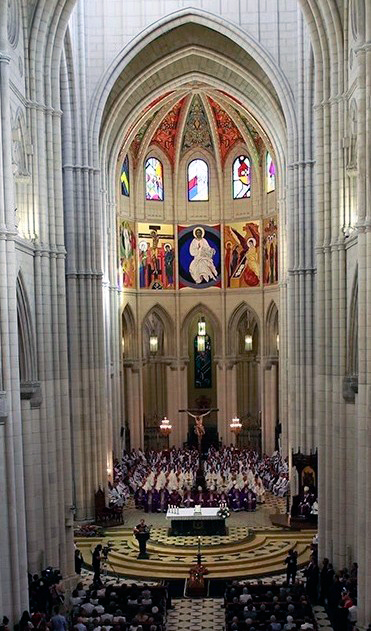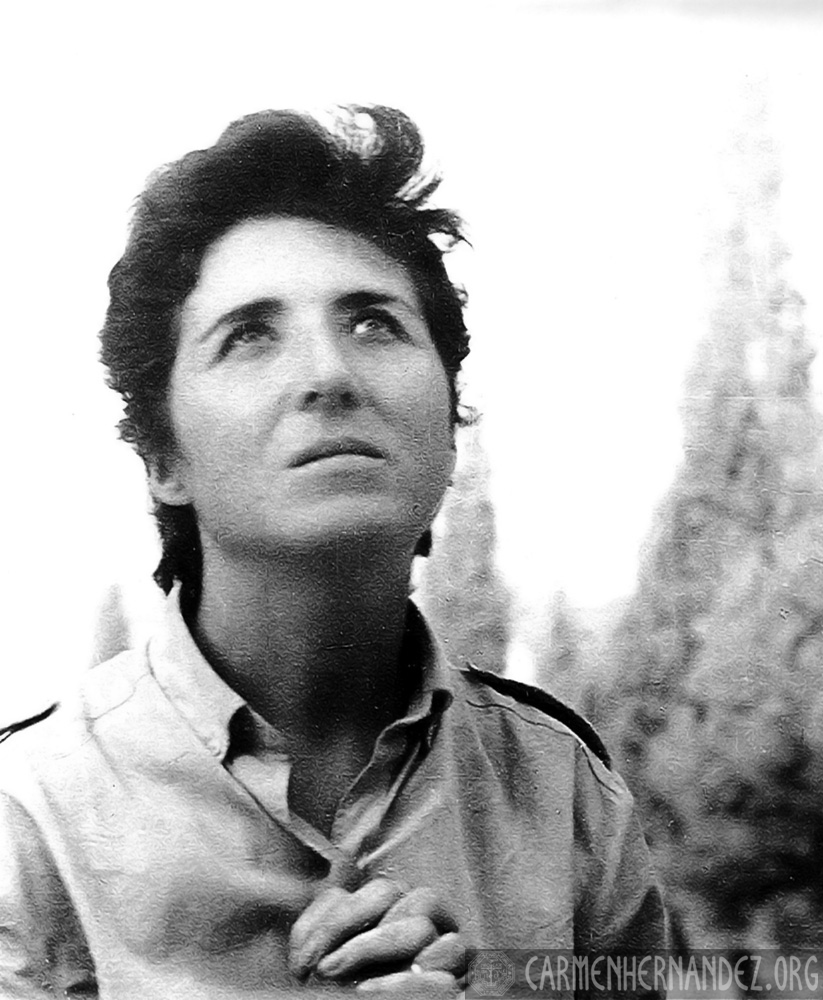
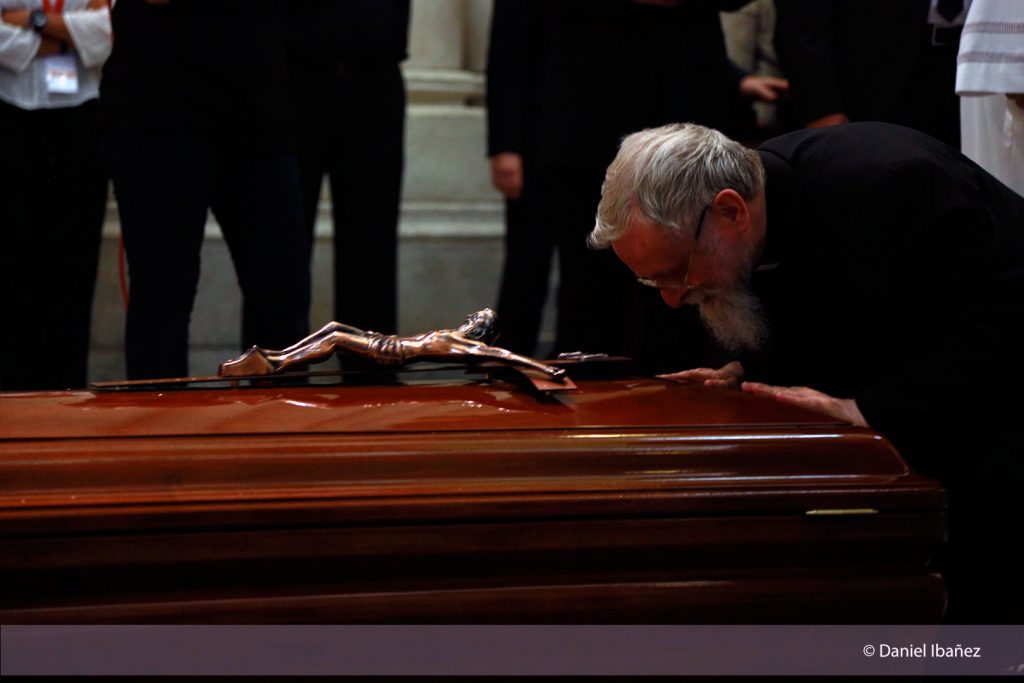
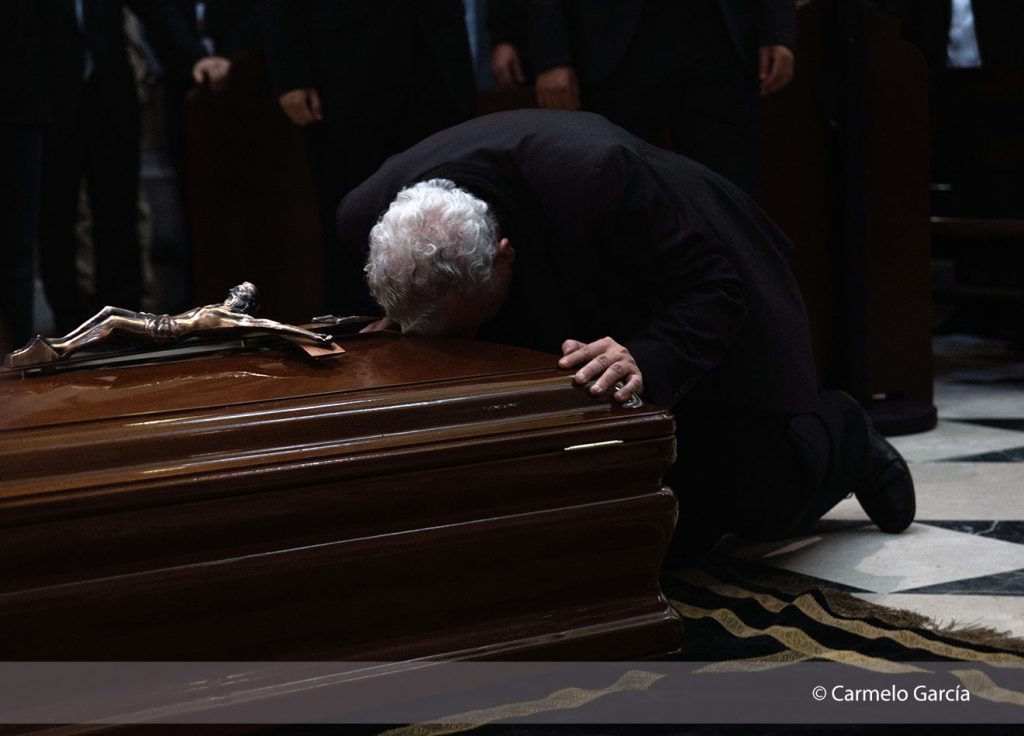
July 19, 2016, was one of the hottest days of that summer in Madrid. Carmen Hernández, after a long illness, had entered her final moments the day before, falling into a sort of coma. Kiko Argüello arrived at noon to see her before she died and said, “It was very moving to me that she waited for me to arrive, so I could kiss her and say, ‘Courage,’ and after I gave her a little kiss, she passed away.” It was a quarter to five in the afternoon. Fr. Mario Pezzi also arrived that afternoon.
When we heard the news, those of us who had known Carmen for so many years were overcome not so much by a sense of shock—as one might feel when a loved one dies—but rather by a sense of serenity, because Carmen had reached her destination: eternal rest with the Lord, of whom she had spoken to us so many times.
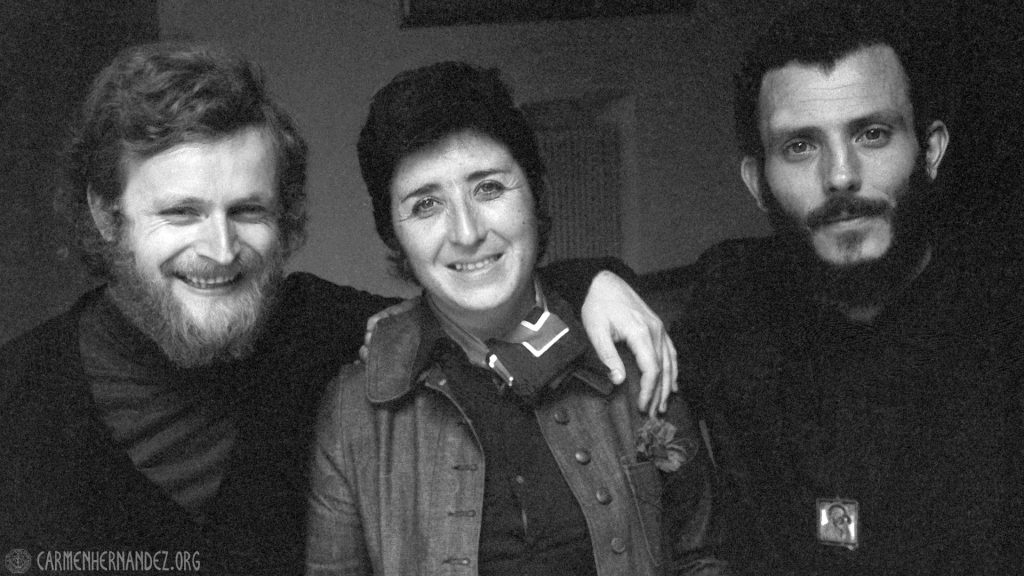
For nearly two full days, day and night, there was a vigil and prayer at the house on Samaría Street, with her body present. This brought great comfort to her family, those close to her, and members of the Neocatechumenal communities and parishes. Yes, her passing saddened us, but there was also a “joy and eternal hope” that Carmen was still alive—now in the Father’s house, with her “Beloved,” as she repeated in her journals like a refrain, referring to Jesus: “My Jesus, my love, my Beloved, I love you.”
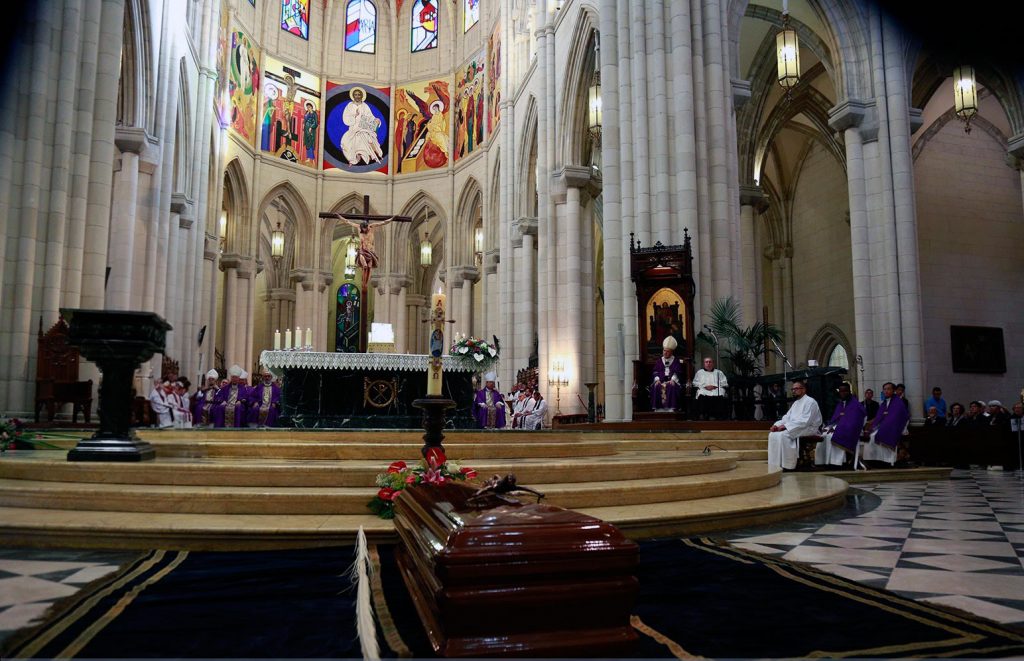
Looking back on that moment and reflecting on the events of the past ten years, one experiences a sort of dizziness, because a vast number of documents come to mind: letters, planners, notebooks, diaries, catechesis sessions, and retreats—both audio recordings and transcripts—as well as trips, testimonies, and so on. What an intense life Carmen Hernández led! It became even more intense when the Lord united her, in her mission, with Kiko Argüello! In the decade since her death, a beautiful mosaic of documents has unfolded before our eyes—like precious tesserae—reflecting “the ineffable work of art” that the Lord has created in her life and in the form of Christian initiation known as the Neocatechumenal Way.
A few months after her death, people began to gather all the documents related to her life. What a surprise! Carmen had kept all kinds of documents: in a leather suitcase and on the shelves of her bookcases, they found all her diaries, in which she had written down, day by day, what she had done that day, what the liturgy had taught her, and other thoughts. That suitcase also contained hundreds of letters she had written or received, some of them neatly organized; in addition, there was a large number of notes and outlines for catechesis, as well as annotations with a high degree of theological depth.
Her remarks at meetings and gatherings, as well as her admonitions and catechesis—all transcribed over the course of his many years of evangelization—were added to the vast amount of documentation we began to collect and classify.
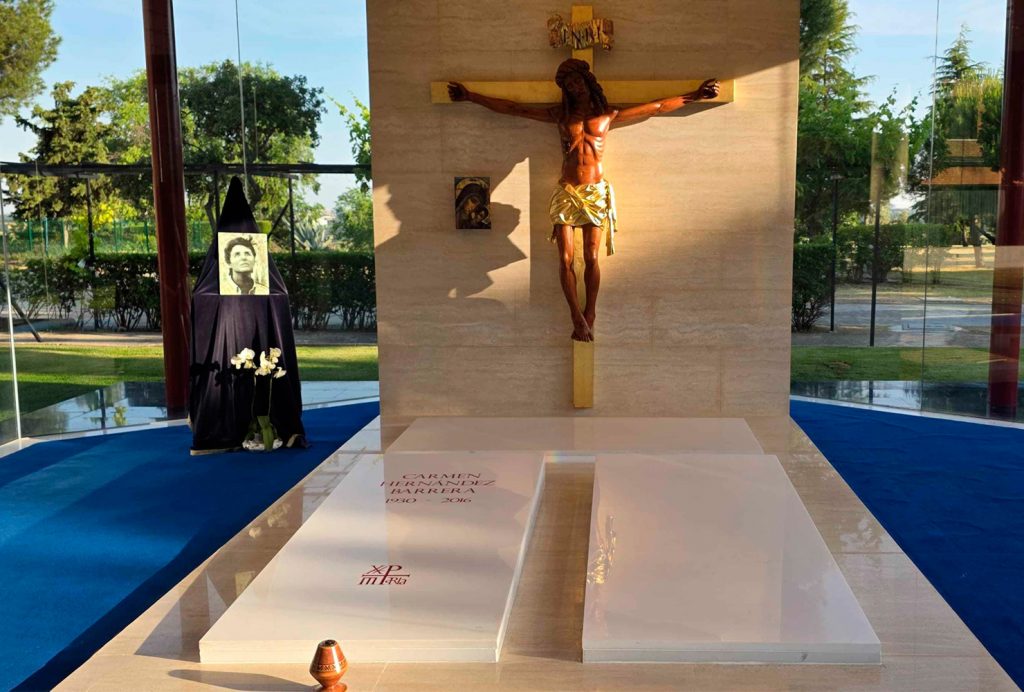
Visits to her grave, which grew in number each year, and the emergence of people who recounted and wanted to put in writing their experiences of meeting Carmen, opened up a new source of material: the testimonies and statements of witnesses who had known her and were grateful for her life. And to top it all off, people began to pray to God through Carmen’s intercession in times of illness, suffering, failure, or minor setbacks in life.
All this reputation for holiness and the reports of miracles prompted us to ask the Archdiocese of Madrid whether the time had come to consider opening a Cause for Beatification and Canonization. Since the answer I received was clearly positive, we continued with even greater enthusiasm on the path we had begun—that is, we had to collect, organize, index, classify, and archive “everything” related to Carmen Hernández and the work that God had accomplished through her. No big deal! Well, let’s get to work. A small group of us, working entirely on a voluntary and altruistic basis, set to work on this task in our spare time.
Working on this project has been a fascinating experience, because it has allowed us to discover many facets of Carmen that we knew little about or were even completely unaware of:
– Her profound love for Jesus Christ, her intimacy with Him, and her almost constant “dialogue” with the Lord. Her love for the Virgin Mary, whom she regarded as her mother. The events of her life were described from a theological perspective; that is, Carmen constantly sought to do God’s will and wanted to know what God’s plan was for her so that she could carry it out.
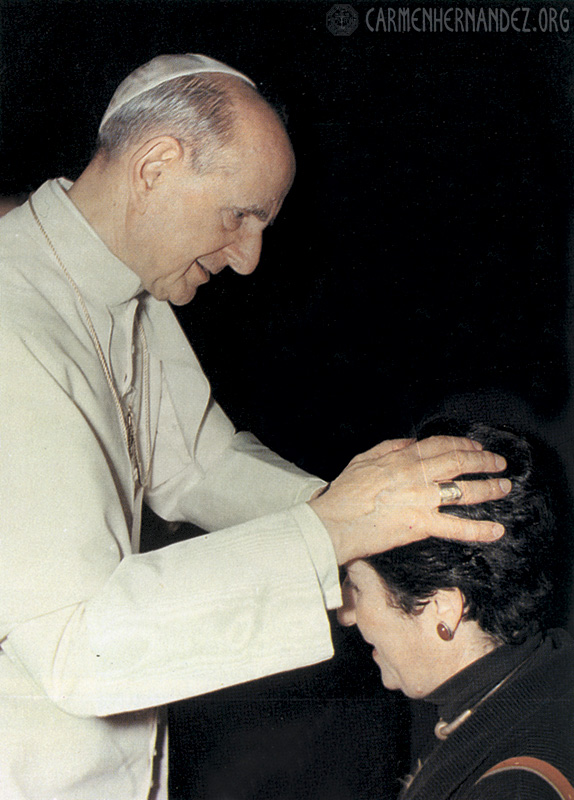
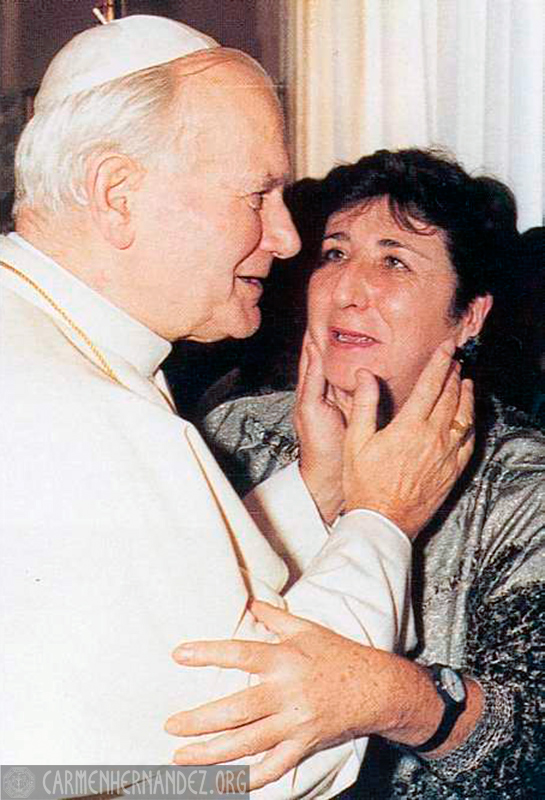
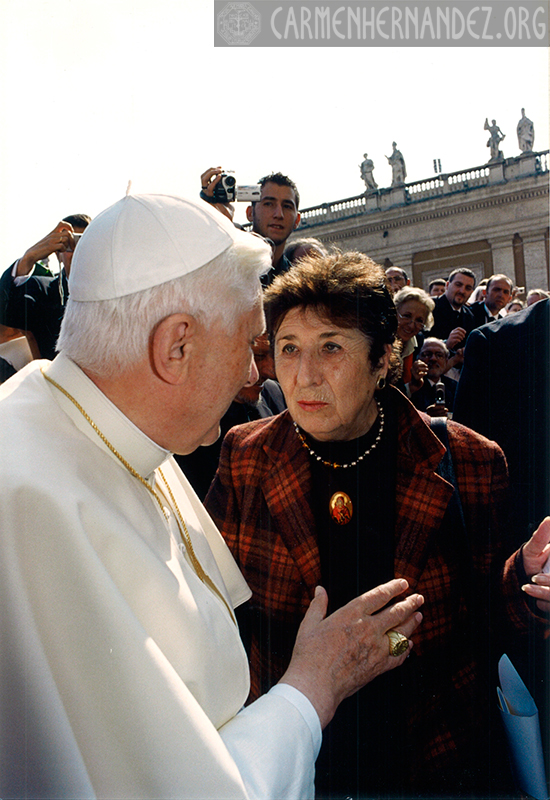
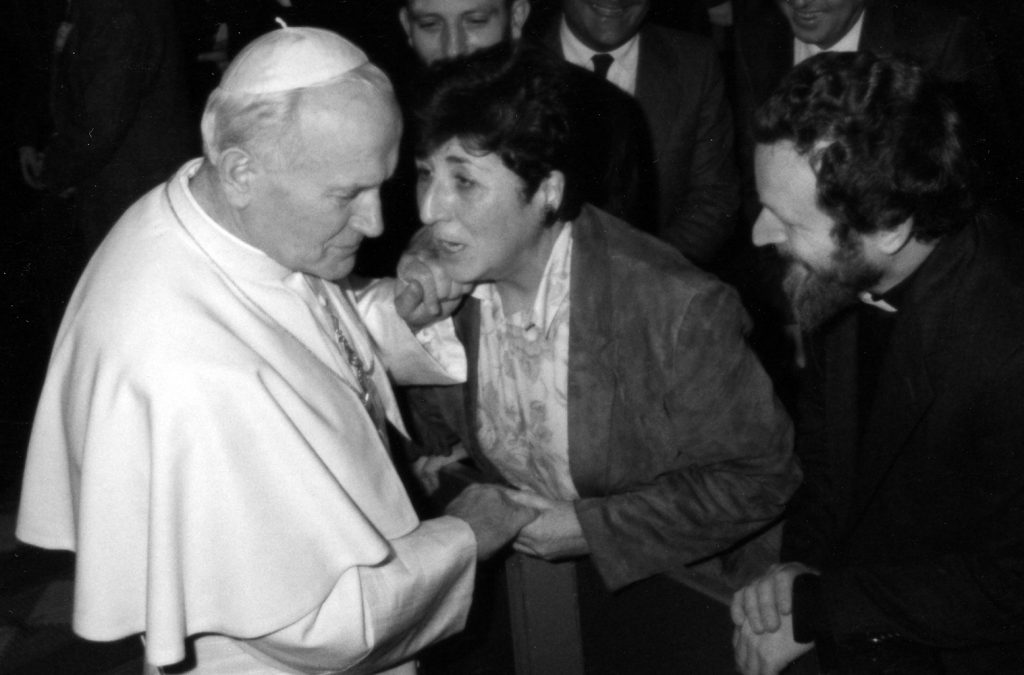
– Her love for the Church, her closeness to and total obedience to the popes, which also extended to the bishops and priests. She did not want to start any new movement, nor to found a new religious order, nor a specialized group within the parish; she wanted “only the Church”—to revitalize the Church and to revitalize the faith of Christians, which comes from Baptism. For this reason, God granted her, together with Kiko Argüello, the privilege of being the initiator of a Journey of rediscovery of Baptism.
– Love and the need for prayer: Carmen prayed the entire Psalter, with true devotion and joy; she enjoyed praying, and it was her way of sanctifying the day. Above all, she loved the Office of Readings, which she called “Matins,” and which she recited at dawn because she said its psalms were “very existential.” She never missed a single hour of the Liturgy of the Hours, even while traveling or on the go.
– Her love for the sacraments, especially the Eucharist, which she received every day, and her love for the Sacrament of Penance. Carmen devoted many years to studying these two sacraments, drawing on the finest Catholic books and the most knowledgeable theologians. She also delved into the Jewish roots of Christianity.
– Her love for the Holy Scriptures, which she knew inside and out, and with which she would spend hours and hours, reading and rereading passages, uncovering countless nuances and meanings. Carmen’s Bibles are underlined over and over again: it’s striking to see how “worn and underlined” they are.
– Carmen Hernández was a tireless student of the Catholic Faith, drawing on the Church Fathers and the entire Tradition of the Magisterium; her libraries contain more than 4,500 religious books and hundreds of theological journals. She listened to Vatican Radio daily and read *L’Osservatore Romano* (underlining and/or clipping out the most interesting articles) in both the daily Italian edition and the weekly Spanish edition. She followed all the popes’ speeches.
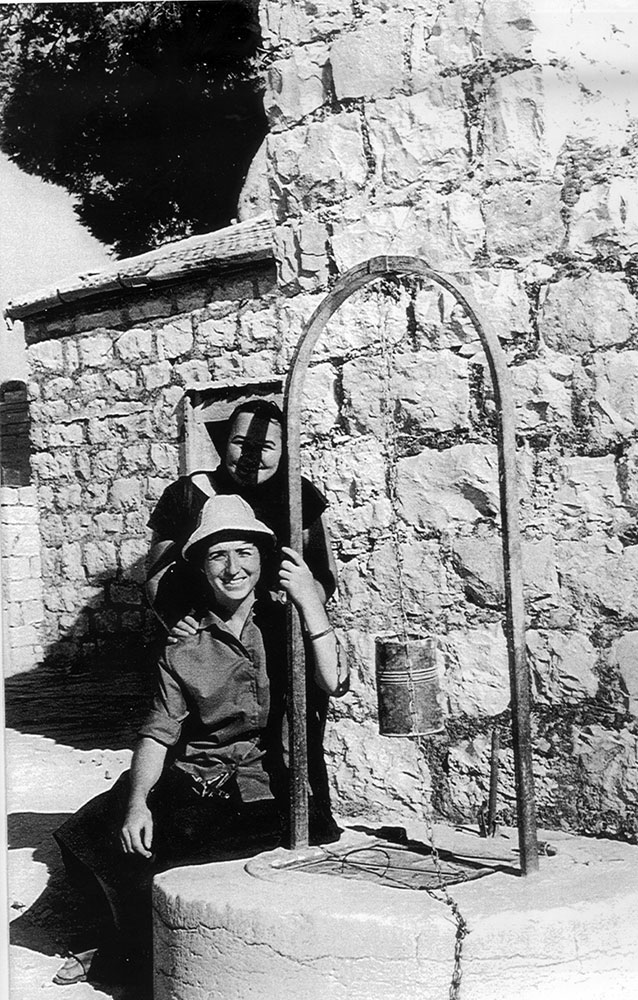
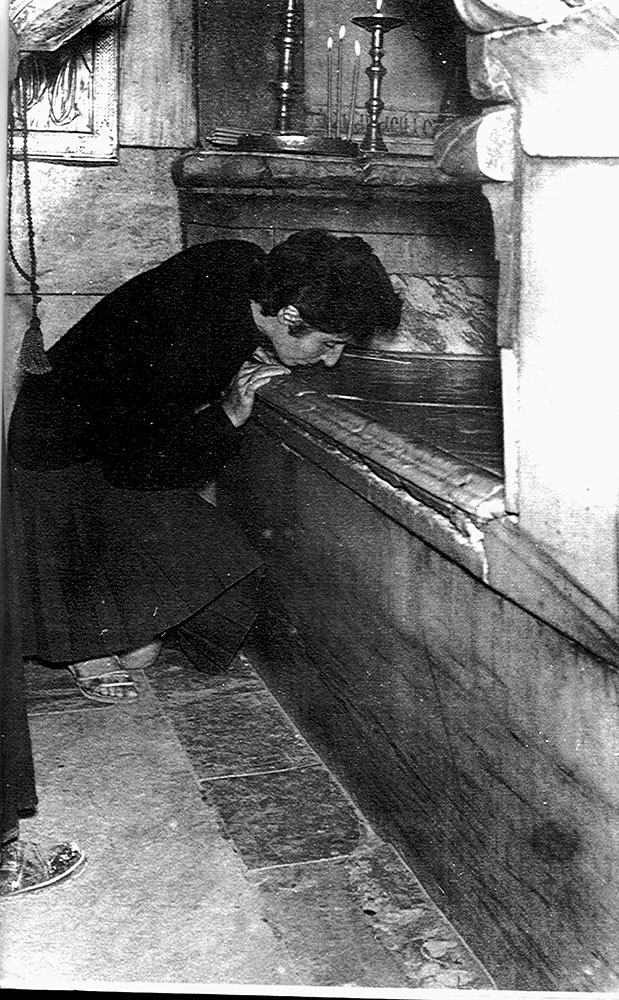
– As part of her preparation to become a missionary, Carmen wanted to travel to the Holy Land as a pilgrim. She made her first trip there in 1963–1964, but returned countless times, because she considered it essential to set foot on and get to know the land where Christ had spent the years of his earthly life. For this reason, she has passed on this great love for the Holy Places—along with her knowledge of the traditions of the Jewish people and their liturgical feasts—to thousands upon thousands of people. She used to say that in Israel, the place where God chose His people, “the Scriptures come alive, because reading them in the very place where the events occurred is a completely different experience.”
– She emphasized, in various ways, the importance of women in the Church, in the family, and in society, because God has given women “the factory of life,” which is their womb. It is the place where God gives life to every human being—unique and original—and women carry that life in their wombs and give it “being.”
– She had a special love for the “lost sheep”—that is, for those who were suffering, or for anyone going through difficult times or facing a crisis; Carmen would call them and encourage them to rediscover Jesus Christ through the sacraments, the Word, and prayer,
All these detailed accounts of Carmen’s life bore fruit: Cardinal Carlos Osoro, then Archbishop of Madrid—who had jurisdiction over the matter because it was the diocese where Carmen had died—accepted on July 19, 2021, five years after her death, the petition to open the Cause for Beatification and Canonization, known as the “Supplex libellus.”
Next, a diocesan tribunal was formed, consisting of the Episcopal Delegate for the Causes of Saints, Fr. Alberto Fernández, the Promoter of Justice, and the Notary Actuary, to begin taking statements from the elderly individuals who had known Carmen, so that their testimony would not be lost. A Historical Commission was also formed, chaired by Fr. Jesús Sánchez, a priest and parish pastor in Valencia, to search through and collect, from as many archives as possible, any documents referring to Carmen. In total, 59 collections from 47 archives and libraries—located in 21 different cities across 9 different countries—were consulted.
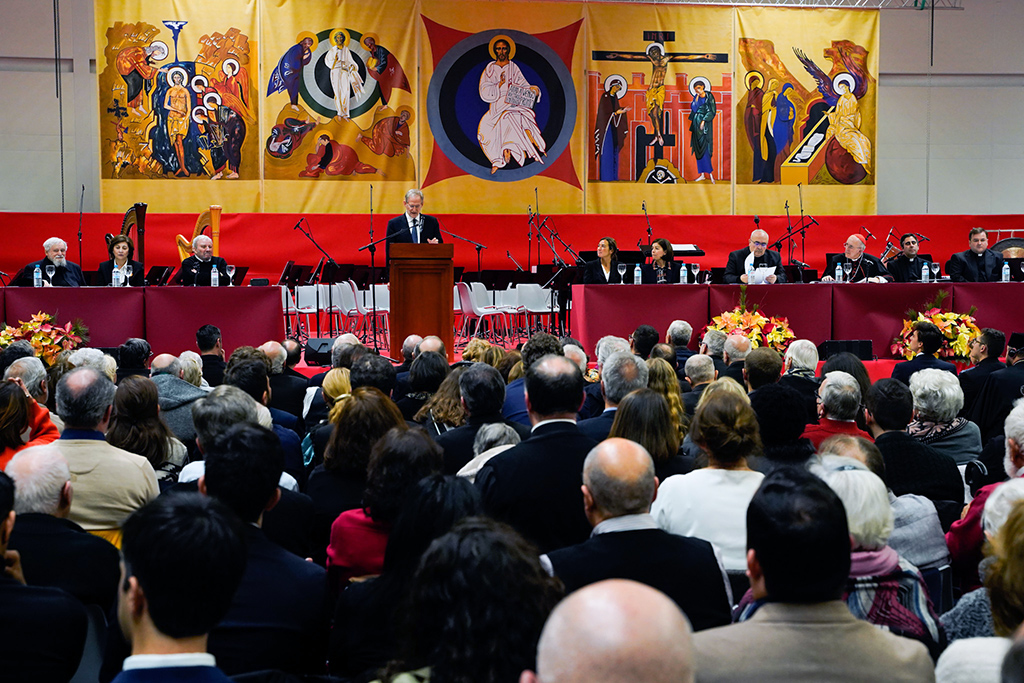
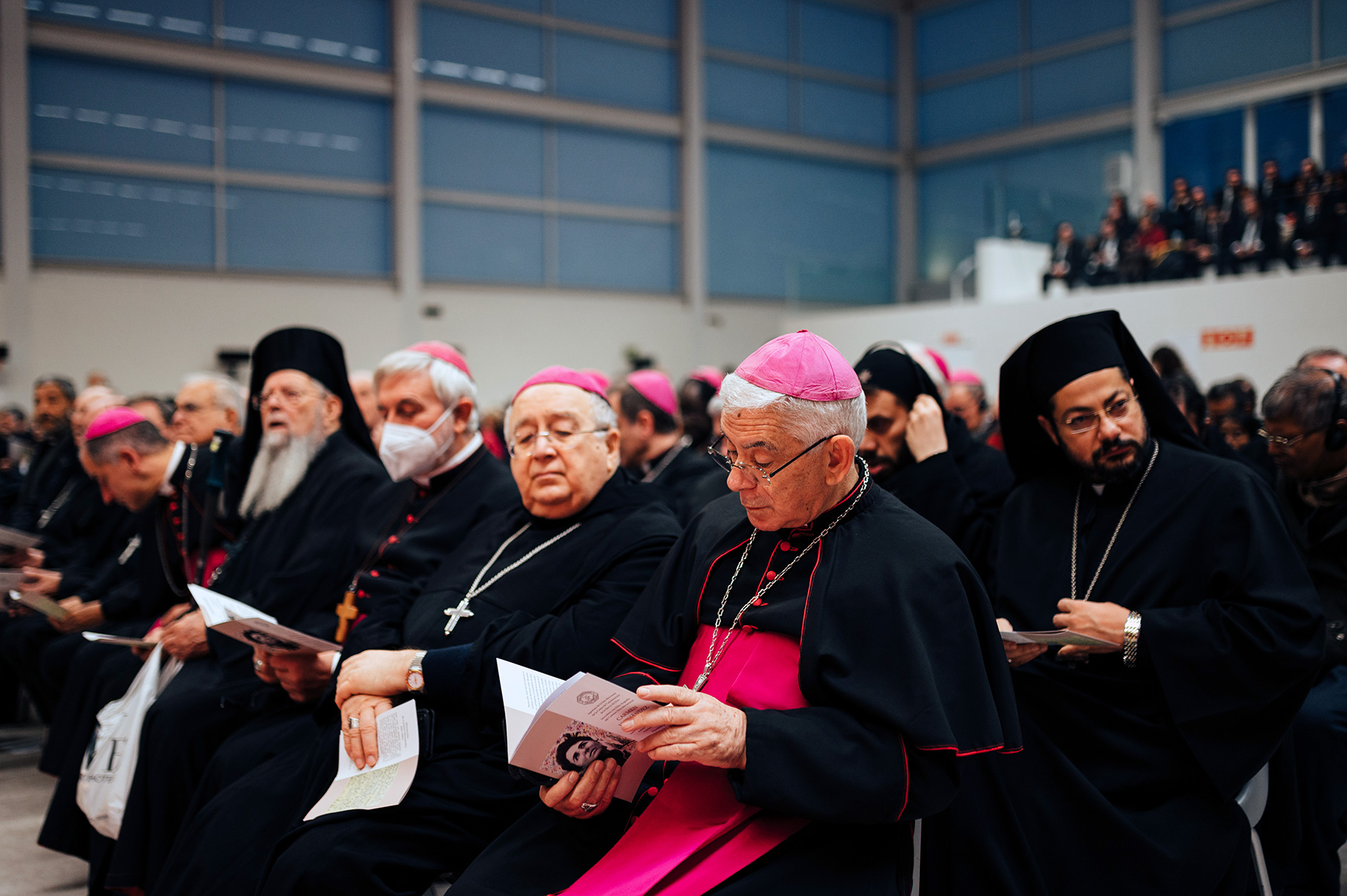
On December 4, 2022, at Francisco de Vitoria University in Madrid, the official opening ceremony for the Cause for Beatification and Canonization of Carmen Hernández—who could already be called a Servant of God—took place. From that moment on, statements were taken from more than one hundred witnesses from a wide variety of backgrounds and walks of life. The written documents continued to be classified, studied, and archived. The total number of documents reached approximately 2,500, comprising some 25,000 pages. Books about her life began to be published: A first biography, very comprehensive and well-documented, has already been translated into 12 languages: Spanish, Italian, French, English, Polish, Portuguese, German, Dutch, Russian, Croatian, and Swedish. In addition, there are 12 more books, including studies of her life and monographs.
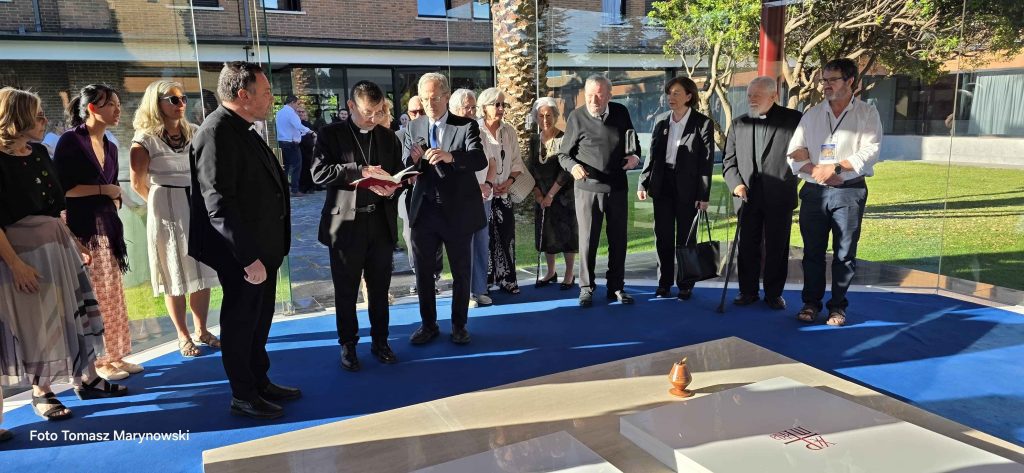
Her reputation for holiness and for performing miracles was also reflected in the thousands upon thousands of people who go to pray at her tomb for her eternal rest, as well as to ask for or give thanks for favors and graces obtained through her intercession. The number has now surpassed 120,000 people from more than 100 different countries around the world, who come individually, with their families, or in small or large groups. They include members of the Neocatechumenal Way and, increasingly, people who are not members but have heard of Carmen. A large portion of the petitions to God made through Carmen’s intercession concern difficulties related to pregnancies, childbirth, and children, as well as other family situations.
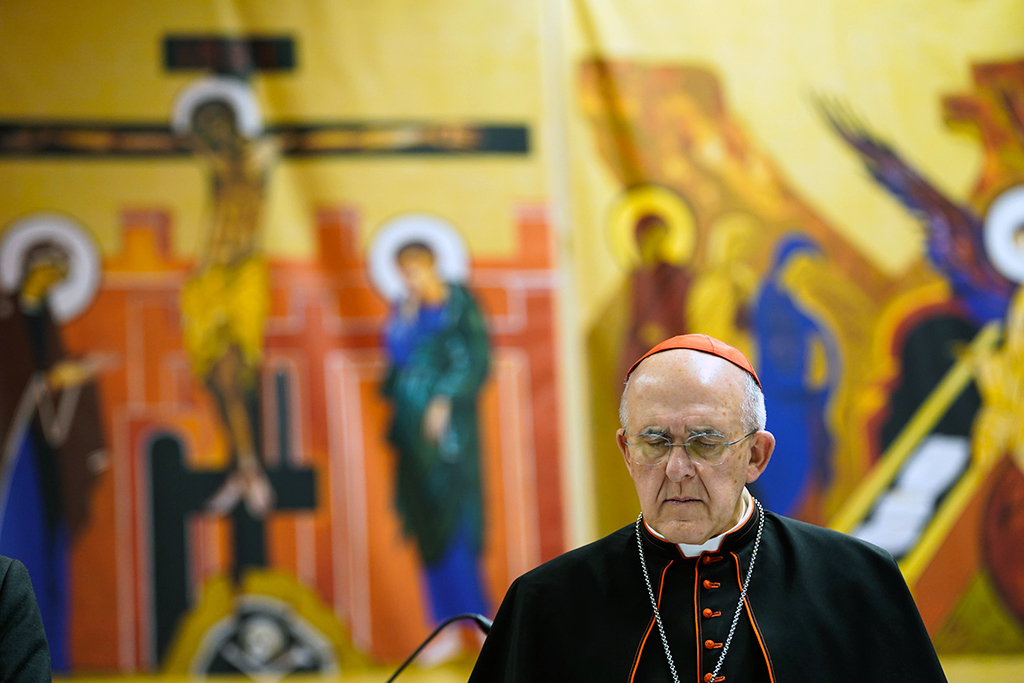
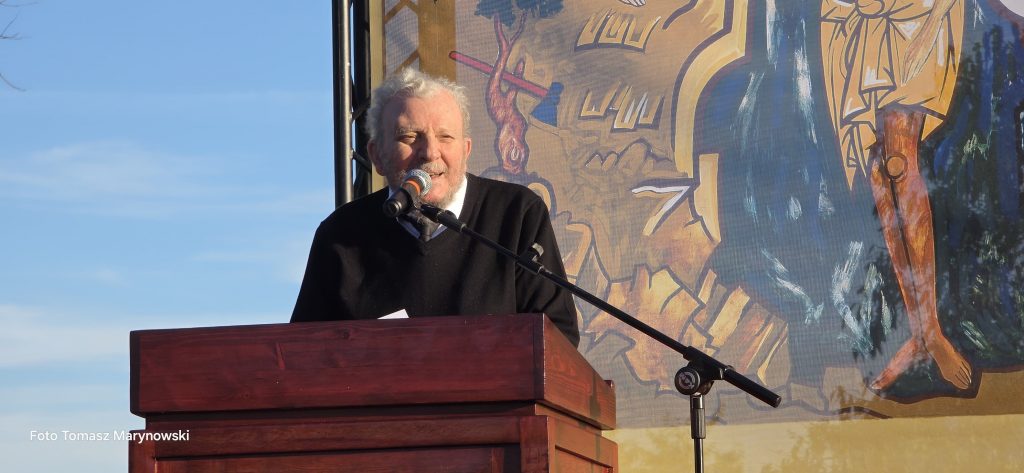
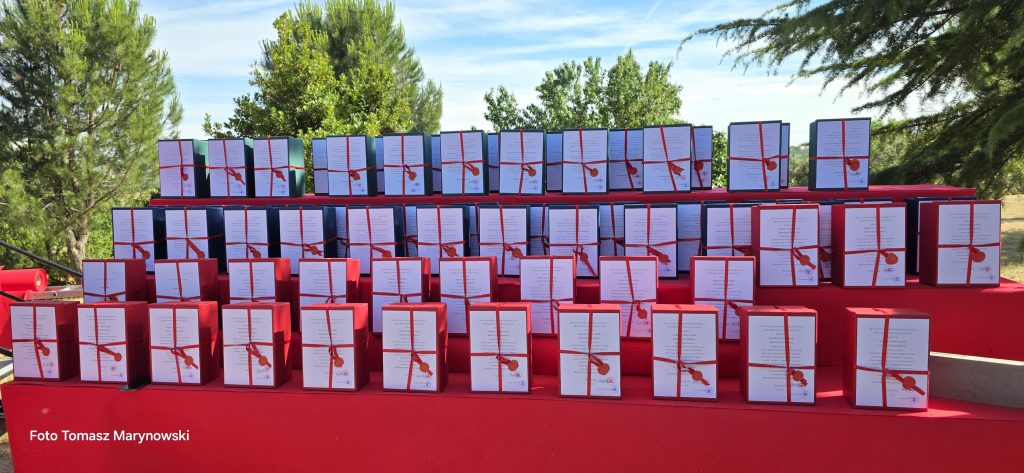
This entire diocesan investigation into the life, virtues, and reputation for holiness of Carmen Hernández concluded with the preparation of the final proceedings, which comprised 25,000 pages and several printed volumes—in the original and two copies—that were packed into 70 boxes. The current Archbishop of Madrid, Cardinal José Cobo, presided over the canonical ceremony marking the conclusion of the diocesan phase on June 2, 2026, at the Redemptoris Mater Seminary in Madrid, very close to the grave of Carmen.
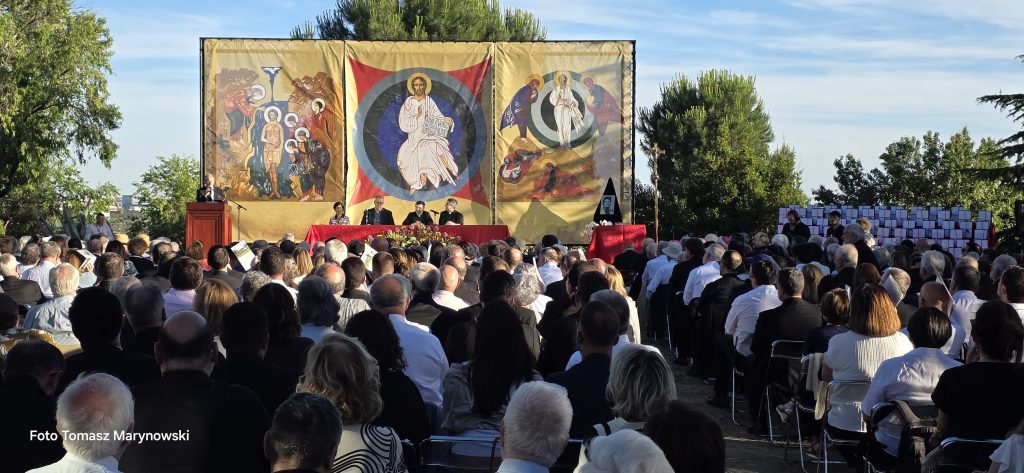
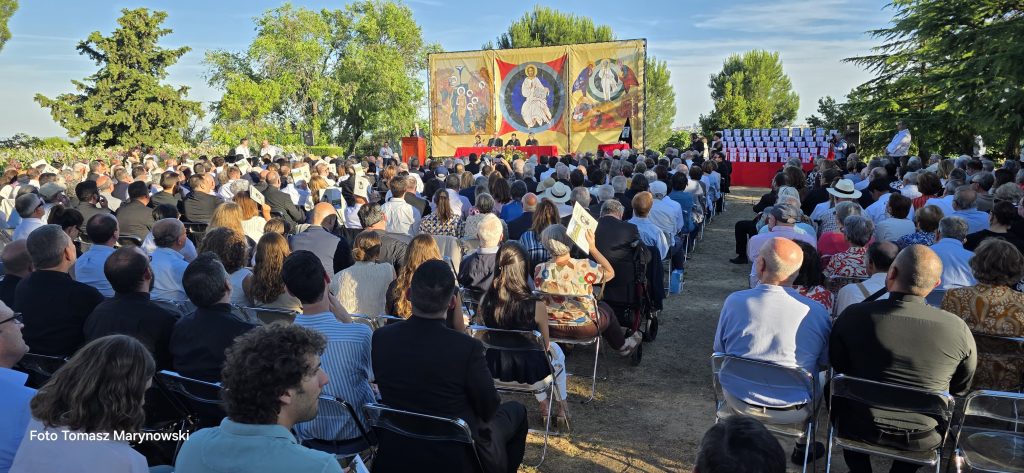
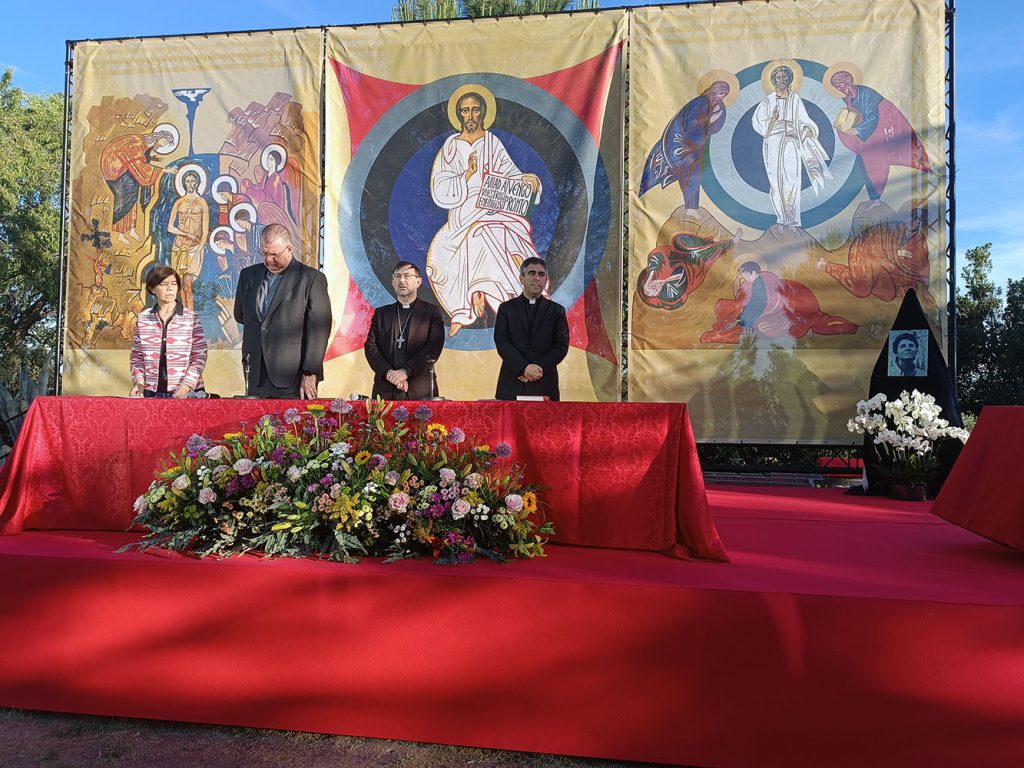
A copy of these minutes was retained in the Diocesan Archives of the Archdiocese of Madrid, and the rest were sent to the Dicastery for the Causes of Saints at the Holy See. The boxes arrived at the Dicastery on June 18, 2026. In this Roman phase of the process, the next step will be to open the boxes for a detailed examination.
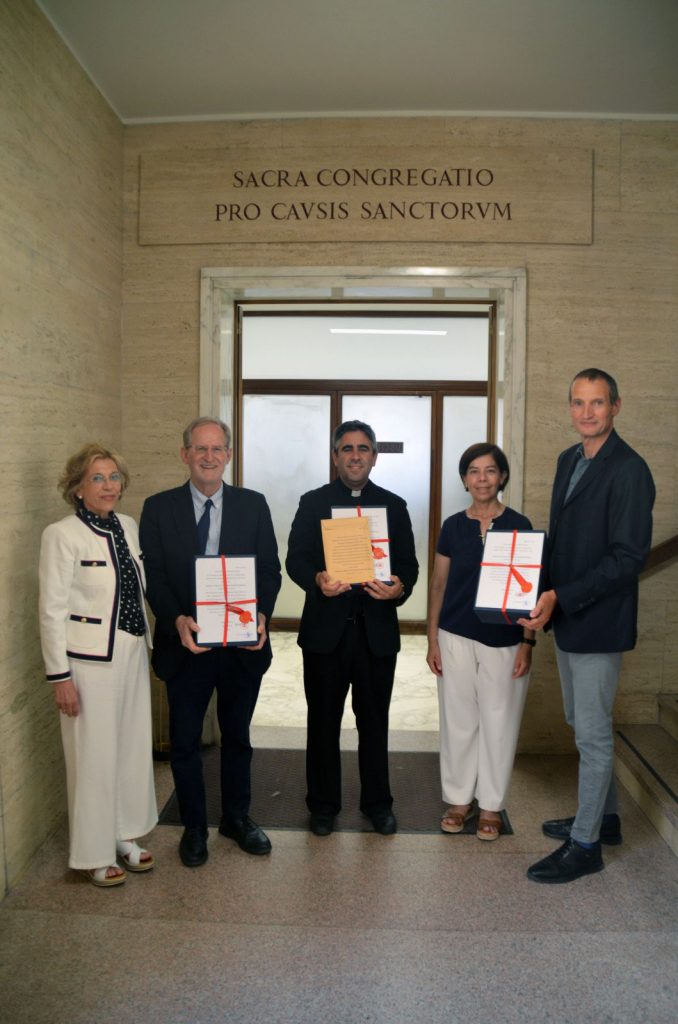
What an intense and fruitful time these past ten years since Carmen’s death have been! Now, on this tenth anniversary, we are entering a new phase in which the Church will continue its careful and wise discernment to evaluate the life, virtues, and reputation for holiness of Carmen Hernández. The Church has the final say.
But in the meantime, we are left with the clear example of an extraordinary woman who spoke with great freedom, who was ahead of her time, and who loved Jesus Christ and the Church deeply. Her life was shaped by itinerant evangelization: for 52 years, she proclaimed Jesus Christ and the Gospel alongside Kiko Argüello, traveling more than 3 million kilometers by plane (equivalent to 77 trips around the Earth), devoting and wearing herself out—often without strength or good health—and following only “the footsteps” that Jesus Christ had set before her.
Kiko recently said: “Carmen has always had the good of the Church at heart. She was a theologian constantly engaged in research and inquiry. Her entire life was marked by her love for Christ and for the Church’s mission.” Let us pray that, during this Roman phase of her Cause for Beatification and Canonization, the Church may confirm to us that she is already enjoying the Lord’s presence for all eternity.
Ten years after her death, her reputation for holiness continues to grow day by day. Proof of this is that on this tenth anniversary of her death, thousands of brothers and sisters on the Way and other faithful from all five continents will gather on Sunday, July 19, beginning with First Vespers, to celebrate the Eucharist and give thanks to God for the life and example of this tireless missionary, Carmen Hernández. In many dioceses, the bishops will preside over this Mass.
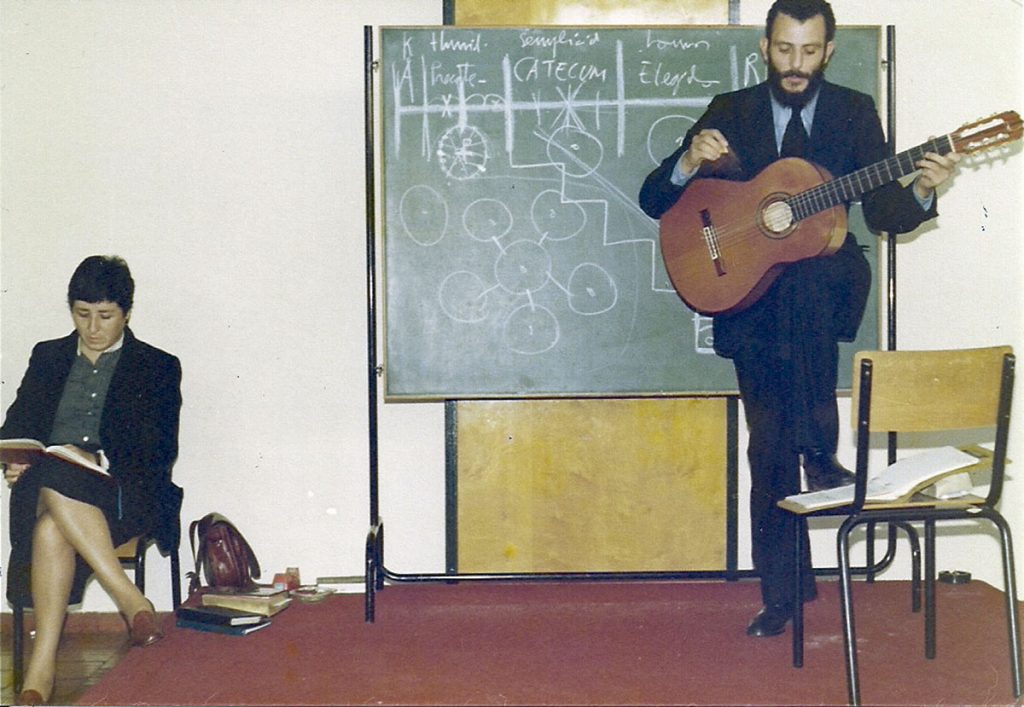
On this anniversary, we have selected the following entries from one of her diaries:
“Even if I were to thank you for all eternity, I could never express even a fraction of the gratitude I feel for the deeply felt vocation You have placed within me—one I never doubted for even a second, despite all my failings. It is Yours, and to You I wish to surrender myself. Watch over me for the time I have left in this exile, and my dearest Mother, let my heart burst before I ever look back. Let this exile end soon so that I may give myself to You.” “Do not allow, my Jesus, anyone but YOU to fill me—for my whole life. Keep me very close to You and love me, for I long for love until I die.” (Diaries 1950)
Carlos Metola
Postulator for the Cause of
Beatification and Canonization
ANNEX:
Some statistics about Carmen’s life, before and after her death.
– More than 50 years of continuous evangelization.
– 56 countries where he has held meetings and gatherings
– 300 cities visited across 5 continents
– 3 million kilometers traveled by plane (77 times around the Earth)
– 12 books published about his life and work, translated into the major languages.
– About 120,000 people have visited her grave.
– About 80,000 entries in the tomb’s guest books
– About 5,200 messages of appreciation and thanks received by mail or email.
Books Published About Carmen (in Various Languages)
– Carmen Hernández Barrera, “Diaries 1979–1981,” edited by J. Sotil and E. Pasotti, BAC, Madrid 2017 (in Spanish, Italian, French, English, Polish, Portuguese, Croatian, Korean, Hungarian, and Russian).
– Carmen Hernández Barrera, “The Necessity of Prayer in the Thought of Pius XII,” edited by R. Orozco and A. Carrascosa, Desclée de Brouwer, Bilbao 2024 (in Spanish, Italian, Portuguese, and Polish)
– Aquilino Cayuela, “Carmen Hernández: Biographical Notes,” BAC, Madrid 2021 (in Spanish, Italian, French, English, German, Dutch, Polish, Portuguese, Croatian, Russian, and Swedish)
– Giorgio Ricci, “Judeo-Christian Symbols Between Science and Faith: Reflections with Carmen Hernández,” Chirico, Naples 2021 (in Italian, Spanish, and English).
– Francesco G. Voltaggio – Paolo Alfieri, “All My Springs Are in You: The Servant of God Carmen Hernández in the Holy Land (1963–1964),” BAC, Madrid 2023 (in Italian, Spanish, English, Portuguese, Polish, and Arabic).
– Carmen Hernández Saldaña, *Women from Soria in History*, Soria Edita, 2023 (with a chapter dedicated to the Servant of God Carmen Hernández Barrera).
– Gianfranco Santini, “A Saint as a Friend: Seven Stories,” Tau Editrice, Todi (Perugia) 2024.
– Josefina Ramón Berná, “Undivided Heart: Mission and Virginity in Carmen Hernández,” BAC, Madrid 2025 (in Spanish, Italian, Portuguese, French, English, German, Dutch, Polish, Chinese, Czech, Romanian, Swedish, and Croatian).
– Charlie Metola, Isabel Banderas, “The Servant of God Carmen Hernández: Her Life and Mission in 50 Questions,” BAC, Madrid 2025 (in Spanish, Italian, Portuguese, Polish, English, and German).
– José Casas – Jorge Borrell. “Light and Darkness, Bless the Lord: The Servant of God Carmen Hernández Barrera in Barcelona (1962–1964).” A Brief Historical Study. Desclée de Brouwer, Bilbao 2026.